Team
Product 1
 Medsync
MedSync offers two products: a ready-to-use AI scribe app for clinics and doctors, and an API for hospitals to build custom clinical AI. Key differentiators are an agentic automation layer for patient follow-ups and a compliance-first architecture with PHI redaction, addressing documentation burden and fragmented records.
Sector
Healthcare
Industry
Healthcare IT
Model
B2B
Technology
AI / ML
Mobile Apps
Web technologies
Product Details
MedSync is a healthcare AI platform built by GoAutomate Pvt Ltd, offering two complementary products:
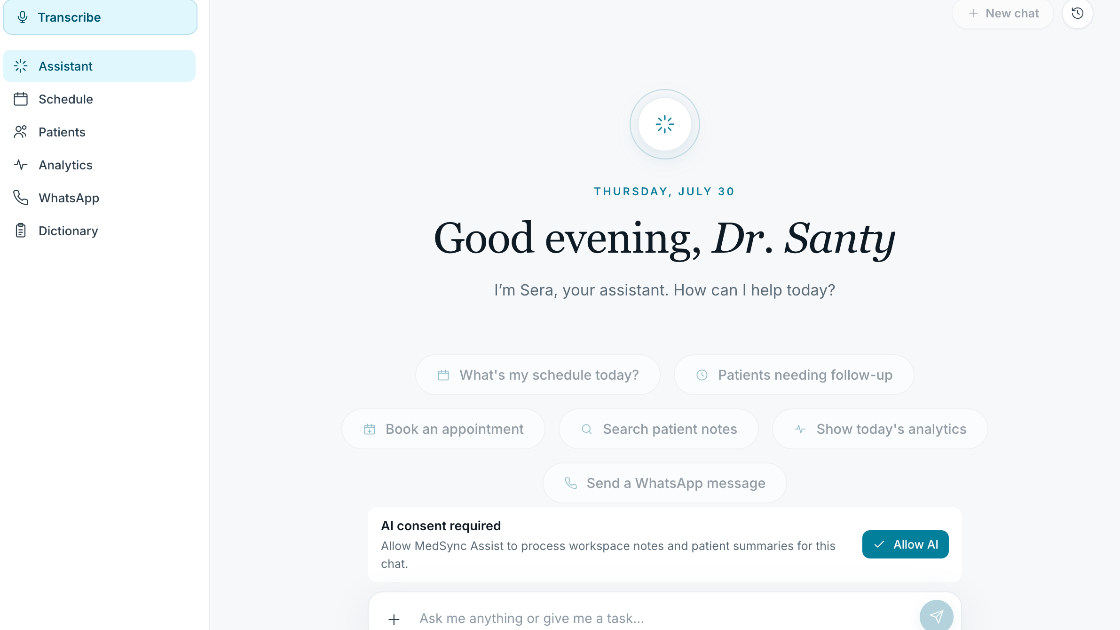
MedSync Clinical App (app.gomedsync.com) — A ready-to-use AI scribe and workflow tool for clinic owners, individual doctors, and practice decision-makers. It listens during patient visits and generates structured clinical notes in real time, eliminating manual documentation. Beyond transcription, it includes an agentic automation layer that handles patient follow-ups, outreach, and history summarization — tasks typically requiring administrative staff time.
MedSync API — Infrastructure for hospitals and health systems that want to build their own clinical AI capabilities in-house, including AI scribing, voice agents, and patient communication tools, rather than relying solely on off-the-shelf vendors.
Key Differentiators:
- Agentic layer: Goes beyond passive transcription to actively automate follow-up workflows and patient engagement
- Compliance-first architecture: PHI is redacted before any data reaches third-party LLM providers, addressing a core trust barrier in healthcare AI adoption
Problems Addressed:
- Clinical documentation burden and physician burnout (well-documented via AMA and Medscape research)
- Scattered, unsummarized medical records
- Low patient engagement and follow-up compliance
- Billing and coding inefficiencies caused by inconsistent documentation
Market Position: MedSync doesn't compete with hospitals already using AI scribe tools (e.g., Nuance DAX, Abridge, Suki) — the API offering enables those hospitals to build proprietary clinical AI instead of depending entirely on external vendors, while the Clinical App directly serves the large underserved segment of individual clinics and practices.