Team


Product 1
 Indexgraph
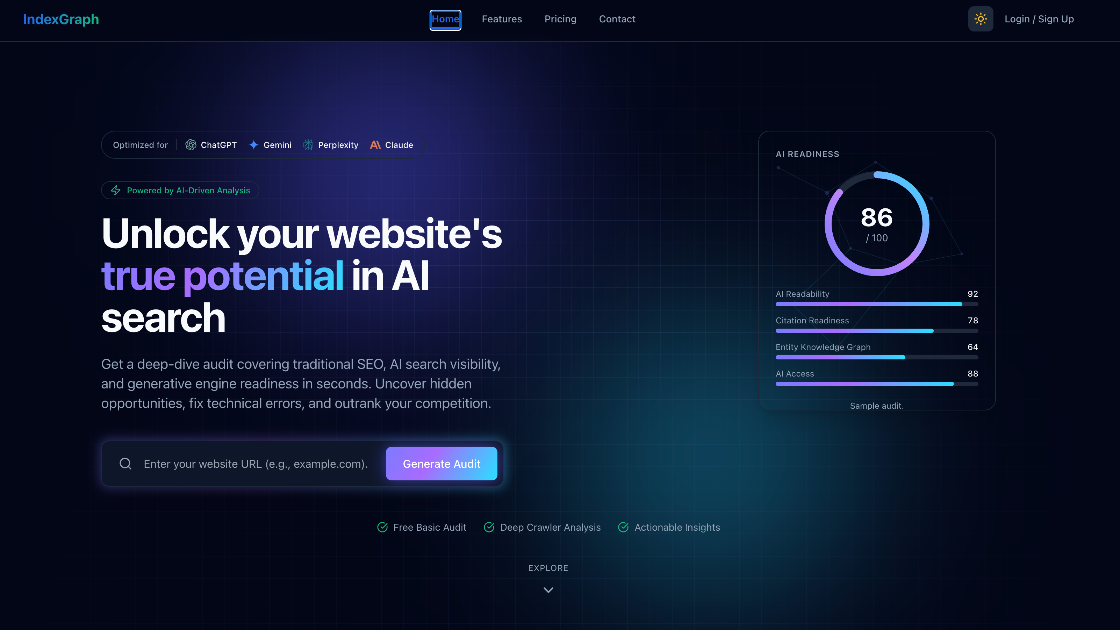
Adexorb is leading SEO,GEO and AI optimization company developed IndexGraph which is AI-first website intelligence platform helping businesses dominate visibility across traditional search and AI answer engines — ChatGPT, Google AI Overviews, Perplexity, Gemini, Claude. One unified audit covers On-Page SEO, Technical SEO, Off-Page SEO, GEO, AEO, AIO, and LLMO
Sector
IT/ITeS
Industry
Enterprise Applications
Model
SaaS
Technology
AI / ML
Web technologies
Indexgraph
Adexorb is leading SEO,GEO and AI optimization company developed IndexGraph which is AI-first website intelligence platform helping businesses dominate visibility across traditional search and AI answer engines — ChatGPT, Google AI Overviews, Perplexity, Gemini, Claude. One unified audit covers On-Page SEO, Technical SEO, Off-Page SEO, GEO, AEO, AIO, and LLMO
Sector
IT/ITeS
Industry
Enterprise Applications
Model
SaaS
Technology
AI / ML
Web technologies
Adexorb Technologies Private Limited
The IT firm focus on SEO,GEO, AIO,LLMO, Web Application Development and Data Analysis.
IndexGraph — Product Details
Overview
IndexGraph is a unified AI-first website intelligence platform that helps brands win visibility across both traditional search engines (Google, Bing) and the new generation of AI answer engines (ChatGPT, Perplexity, Claude, Google AI Overview, Gemini). It replaces five fragmented toolstacks — traditional SEO platforms, AI optimization tools, content audit tools, technical crawlers, and competitive intelligence software — with a single integrated audit and optimization engine.
The Market Shift
Search behavior is undergoing the largest disruption since Google's launch. Users increasingly skip the traditional ten blue links and ask AI engines directly: "What's the best CRM for a 50-person team?" "How does GST work in India?" "Compare Stripe and Razorpay." AI engines synthesize answers by citing specific brands and pages — and brands not cited inside these answers are invisible to a fast-growing share of search traffic. Existing SEO tools (Ahrefs, Semrush, Surfer) optimize for Google's keyword rankings, not for how AI engines crawl, extract, and cite content. IndexGraph is purpose-built for this new layer.
Core Capabilities
The platform delivers seven optimization categories from a single dashboard:
1. GEO (Generative Engine Optimization) — Eleven integrated tools including per-engine composite scores for ChatGPT, Perplexity, and Claude; cross-engine Visibility Monitor; AI Crawler Audit (verifies GPTBot/ClaudeBot/PerplexityBot access); Fact Density Optimizer; Prompt Coverage Analyzer; Competitor Citation Tracker; AI List Inclusion Finder; AI Traffic Attribution via GA4; Domain Benchmark Engine.
2. AEO (Answer Engine Optimization) — Ranking Signals audit covering section density, freshness, schema, format, readability, answer quality, and semantic depth; Content Optimizer; E-E-A-T Signal Analyzer; Voice Search Optimizer.
3. AIO (AI Overview Optimization) — Google AI Overview-specific auditing covering schema, embedding match, factual accuracy, multimodal signals, semantic clustering, and grounding probes.
4. LLMO (Large Language Model Optimization) — Content reformatting engine that restructures pages for optimal LLM extraction and citation.
5. Technical SEO — Sitemap validation, robots.txt analysis, render testing, crawlability audits, Google Search Console integration.
6. On-Page SEO — Heading structure, internal linking, content scoring, schema generation.
7. Off-Page SEO — Backlink authority analysis competitor link gap, citation tracking.