
Team




Product 1
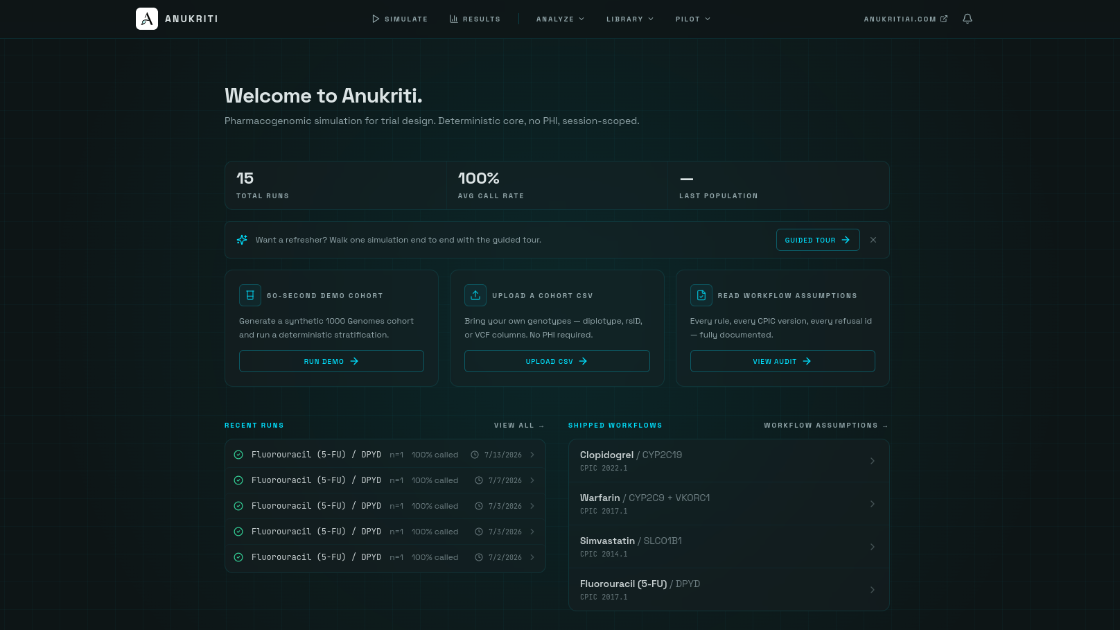 Anukriti PGx Inference Engine
VCF-to-clinical-guidance pipeline covering 13 genes and 38+ drugs. Outputs FHIR R5 reports with 21 CFR Part 11 audit trails. Population-aware overrides flag risks European guidelines miss. Live API, 638+ tests, published on PyPI. DPIIT-recognized. Targeting CROs for pre-trial cohort stratification.
Sector
Healthcare
Industry
Healthcare IT
Model
SaaS
B2B
Technology
AI / ML
Biotechnology
Big data
Anukriti PGx Inference Engine
VCF-to-clinical-guidance pipeline covering 13 genes and 38+ drugs. Outputs FHIR R5 reports with 21 CFR Part 11 audit trails. Population-aware overrides flag risks European guidelines miss. Live API, 638+ tests, published on PyPI. DPIIT-recognized. Targeting CROs for pre-trial cohort stratification.
Sector
Healthcare
Industry
Healthcare IT
Model
SaaS
B2B
Technology
AI / ML
Biotechnology
Big data
Anukriti's pharmacogenomics inference engine processes VCF files through a deterministic pipeline: variant calling → star allele translation → phenotype assignment (PM/IM/NM/RM/UM) → CPIC guideline lookup → population-aware risk assessment → FHIR R5 clinical report with 21 CFR Part 11 audit trail. The engine covers 13 genes with deterministic callers (CYP2D6, CYP2C19, CYP2C9, DPYD, SLCO1B1, VKORC1, HLA-B, HLA-A, TPMT, NUDT15, CYP3A5, CYP2B6, CYP4F2) and 38+ drugs across 13 clinical categories including oncology, cardiology, psychiatry, and pain management. Unlike LLM-based tools, the clinical decision path is fully deterministic — same input always produces identical output, traceable to CPIC version and PMID. The engine includes 31 named-refusal rules (R1-R12, V1-V10, U1-U9) that trigger honest refusals when evidence is insufficient for a given gene-drug-population combination. Population-aware overrides flag risks that European-based CPIC defaults miss, with explicit support for South Asian (SAS), African (AFR), American (AMR), East Asian (EAS), and European (EUR) super-populations plus sub-population granularity. The engine is live at product.anukritiai.com, published on PyPI as anukriti-pgx-core v0.5.0, with 638+ passing tests and validated on HG01190 (a real South Asian reference genome from 1000 Genomes).